

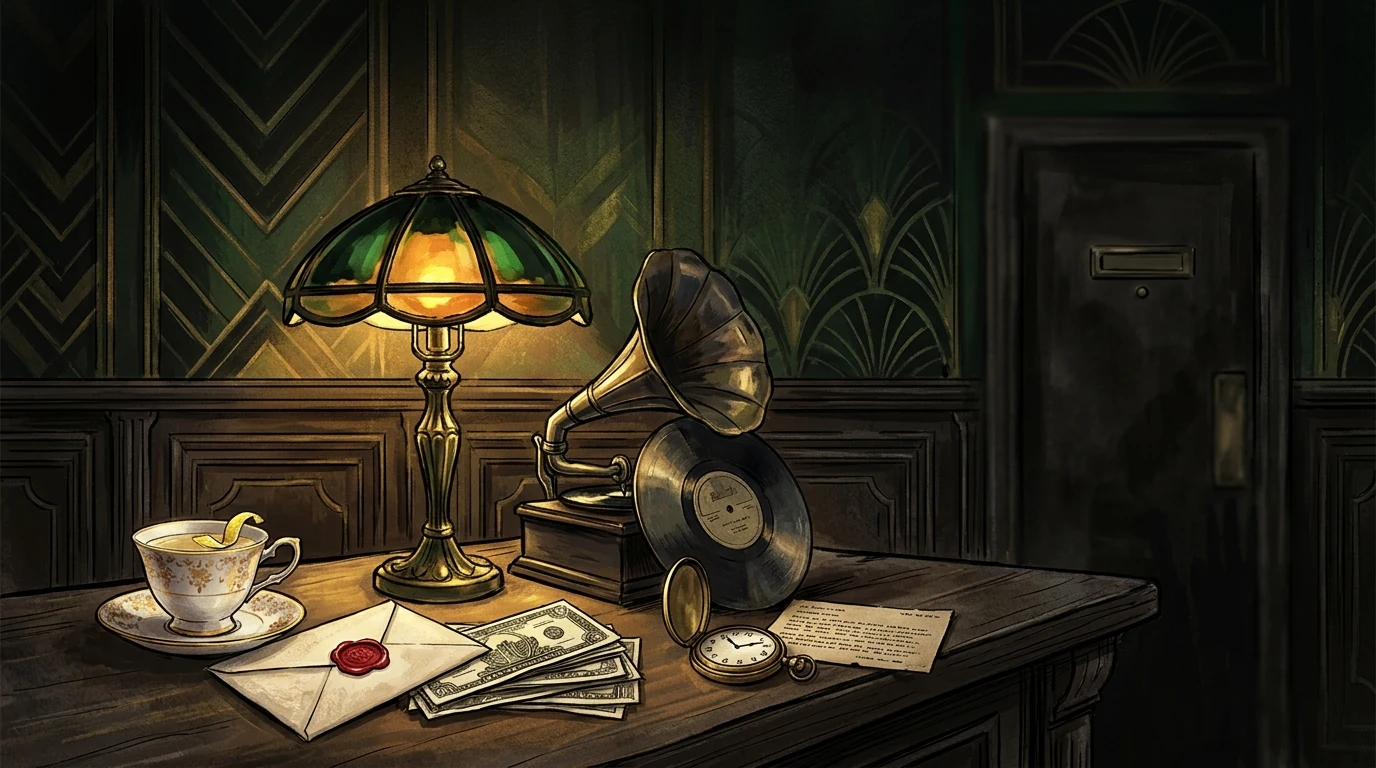
A 1920s speakeasy is the easiest murder mystery theme to dress for and the easiest to over-decorate. Most advice for a "roaring twenties party" is written for a Gatsby costume party, where the job is atmosphere and nothing else. A murder mystery is a game with a clock. Guests have to read cards, find each other, whisper, and hear you when a body drops. Several of the best-loved speakeasy touches fight all four.
So this guide does two things. It goes through the door, the light, the music, the drinks, the food and the costumes, and for each one says how to keep the 1920s feel without slowing the game. Then it walks through a whole night, hour by hour, using the run of our own speakeasy game, Last Call at the Gilded Canary, as the worked example. The timings carry over to any 1920s mystery.
Why a speakeasy party and a speakeasy mystery aren't the same night
A costume party succeeds if the room looks right and people stay late. A mystery succeeds if, at 9:45, everyone has an opinion about who did it. That means four practical needs a decor list never mentions: light to read by, quiet corners to scheme in, a table for evidence, and a host who can stop the room. Keep those four in mind and every choice below gets easier.
The theme itself is real history, which helps. National Prohibition ran from January 17, 1920 to December 5, 1933 Wikipedia, and the bootleggers, crooked cops, temperance crusaders and nightclub singers of those years are a ready-made cast of people with secrets. You don't have to explain the setting to anyone. Your guests already know it from films.
The door: make the password the welcome, not a queue
A password at the door is the best five-second bit of theatre you can do, and it's an old one: the word "speakeasy", for a place where you kept your voice down about the bar, was in use before Prohibition, back to at least the 1880s Wikipedia. Print the password on the invitation and have someone (you, or a guest who arrives early) ask for it at the door.
The trap is turning the door into a bottleneck. If every arrival gets a long bit, you're still doing the door at 7:30 and the first round hasn't started. Keep it to the password, a line of welcome, and then the useful part: hand over the guest's character packet, name tag and play money right there. A guest who walks in already holding their card starts playing on the way to the bar.
Light: amber, not darkness
Dim, warm light makes a living room look like a speakeasy faster than any decoration. Turn off the overhead lights and use lamps with warm bulbs, plus candles for show. But a room lit only by candles is a room where nobody can read a character card, and the evidence you lay out after each murder becomes a pile of paper people squint at.
The fix is one bright spot. Put a proper lamp over the evidence table, and another near wherever guests open their envelopes. The rest of the room can stay moody. If you only change one thing from your decorating plan, change this.
Music: jazz, low, and a way to cut it
A 1920s playlist is easy to get right. Louis Armstrong's Hot Five recordings were made in Chicago between 1925 and 1928 Wikipedia, Bix Beiderbecke and Frankie Trumbauer cut "Singin' the Blues" in 1927, and Duke Ellington started at the Cotton Club that December. Search for any of those names, or simply "1920s jazz", and you have three hours of music.
Keep it quiet enough that two people can trade a secret without shouting. More important, make sure you can stop it instantly, from your phone or a speaker within reach. Cutting the music is the cleanest way to gather a talking room, and it turns every murder into an event: the band stops, the host steps up, and everyone knows something has happened.
Drinks: serve gin, not a fog
A bar is the heart of a speakeasy night, and it should sit somewhere central, because half the plotting happens around it. The classic gin cocktails all suit the theme: a Bee's Knees (gin, lemon, honey), a Southside (gin, lime, sugar, mint, which legend ties to Chicago's South Side, though its origin is disputed), a Gin Rickey (older than Prohibition, from the 1880s), or a French 75 topped with sparkling wine. A fun touch with a real history behind it: some speakeasies poured liquor into teacups so it looked like tea if the police walked in. Serve one cocktail in teacups and people will talk about it.
Two cautions that matter more for a mystery than for a party. First, batch one or two drinks in a punch bowl rather than mixing to order, or the host turns into the bartender. Second, go easy on the strength. Guests have to remember who said what about whom, and the deduction falls apart through a fog. Make a good non-alcoholic version of your punch, label both bowls, and you'll find plenty of people choose the soft one so they can win.
Food: finger food that keeps people standing
The biggest structural mistake at a 1920s mystery is the sit-down dinner. A plated meal fixes everyone to one seat beside the same two neighbours for an hour, during the exact part of the night when they should be moving around, cornering suspects and trading clues. It also puts the host in the kitchen when the timeline needs them.
Period finger food solves both. Deviled eggs, seafood cocktails (oysters were the 1920s favourite; shrimp is easier), little sandwiches, cheese and crackers, nuts in bowls. If you want something more ambitious, Waldorf salad dates to the 1890s and Oysters Rockefeller to 1899, so both would have been on a fancy 1920s menu. Put everything out before the first murder, then refresh the platters during a quiet stretch in the middle of the night rather than on a schedule of courses.
Costumes: give guests more than flapper or gangster
"Flapper dress or pinstripe suit" is a costume brief everyone can meet from their own wardrobe, which is why the 1920s is such a forgiving theme. A drop-waist dress, a long string of beads and a headband; a suit, a fedora and two-tone shoes. Strictly, a 1920s gentleman's evening wear was a tuxedo, but the gangster look is the shorthand every guest recognises, and nobody at your party will mind.
The way to make costumes better is to give each guest a character with a specific look rather than a decade. In the Gilded Canary, the cast includes a headline singer in a slinky gown and a white feather boa, a cigarette girl with a tray made from a box lid on a ribbon, an off-duty detective in a rumpled trench coat, and a banker with a pocket watch and an unlit cigar. Those are easy to put together and they tell everyone in the room who you are before you say a word. Send each guest their costume idea with the invitation, two or three weeks out, and most will arrive in it.
The night, hour by hour
Here is how a three-murder speakeasy night runs, with doors at 7:00. These are the times from the Gilded Canary; shift the whole thing earlier or later to suit you. The right-hand column is what you're doing with the room, which is the part most party guides leave out.
| Time | The game | The room |
|---|---|---|
| 7:00 | Doors. Password, packets, name tags and play money. | Lamps on, music low, food and punch already out. |
| 7:05 | Guests read their cards and start mingling: deals, bribes, gossip. | Stay out of the kitchen. Steer anyone standing alone towards someone on their card. |
| 7:40 | Murder 1. Read it aloud, lay out the evidence, everyone opens envelope 1. | Cut the music to gather the room. Evidence goes under the bright lamp. |
| 8:30 | Murder 2. New evidence, envelope 2. | Refresh the food just before or just after, while people read. |
| 9:15 | Murder 3. Final evidence and final envelope. | Last top-up of drinks; switch to the soft punch if anyone needs it. |
| 9:20 | Last call: the final push to trade clues and corner suspects. | With 11 or more guests, stop the music once so the big table catches up. |
| 9:45 | Ballots: who did it, how and why. Then the solution, read slowly. | Everyone in one room, seated if possible, music off. |
| 10:00 | Awards. | Music back up. Anyone who wants to dance the Charleston can now. |
Two things make this timeline work. The murders come at fixed times, so you can set phone alarms and stop thinking about the clock. And the dead don't sit out: in our games a murdered character comes back as a ghost who can tell anyone anything on their card, so being the first victim is one of the best parts of the night rather than the worst.
Eight guests or twenty: plan the room for the number
With eight, everyone fits around one bar and every conversation is half-overheard, which is part of the fun. With twenty, the party splits into knots, and a clue that one guest learns at 9:15 might never cross the room before the vote. That's why big tables need a moment where the host gets everyone's attention and a few key facts are said out loud.
The guest count also decides how you plan casting. If your game is written for exactly ten and two people cancel on the day, their clues go home with them. Choose a game that carries the case on a fixed core cast and adds extra characters on top, so a late cancellation just means printing one fewer packet. Our step-by-step hosting guide covers the guest list, invitations and printing in more detail.
Your speakeasy checklist
- Password on the invitation, with each guest's character and costume idea
- Packets, name tags and play money handed out at the door
- Warm lamps everywhere, one bright lamp over the evidence table
- A quiet jazz playlist you can stop from where you stand
- A batched gin punch and a labelled non-alcoholic one, one cocktail in teacups
- Finger food out before the first murder, no seated courses
- Phone alarms set for each murder and the vote
- Ballots, pens and awards ready before 9:45
If you'd rather not write the case yourself, Last Call at the Gilded Canary is a complete 1927 Chicago speakeasy mystery for 8 to 20 guests: character packets with sealed envelopes, evidence, Canary Cash, action cards, invitations and a host guide with every line to read. It's one of our three games, and you can download a free five-page sample before you buy.